When time management breaks down in a dental practice, the effects compound quickly. A provider running behind before mid-morning sets off a chain reaction that can last all day, causing rushed appointments, stressed staff, and patients waiting longer than expected. By afternoon, the team is worn down, the schedule has drifted, and revenue that should have been captured is gone.
Poor time management for dental practices follows predictable patterns, though, and those patterns can be fixed by a few time management best practices for dental offices.
Key Takeaways
- 01 Block scheduling fills your most valuable time slots with complex, higher-revenue procedures first, then fits routine appointments around them so your day stays steady and productive.
- 02 Sending a text reminder one week out and another the day before an appointment is one of the simplest ways to cut down on no-shows without adding work for your front desk.
- 03 Tracking how long procedures actually take across multiple appointments gives you real data to build scheduling templates from, so you stop guessing and start planning accurately.
- 04 When confirmations, insurance checks, billing steps, and intake forms run automatically, your staff can spend their time on things that actually need a person handling them.
- 05 Good dental software includes reminders, online scheduling, digital forms, appointment checklists, and production dashboards all in one place rather than requiring separate tools for each.
Effective time management for dentists doesn’t require working longer hours or overhauling everything at once. What it requires is clarity: knowing which systems to build, where inefficiencies actually live, and what tools can take the manual load off your team.
Review the most effective dental practice time management tips below:
1. Build Your Schedule Around Block Scheduling
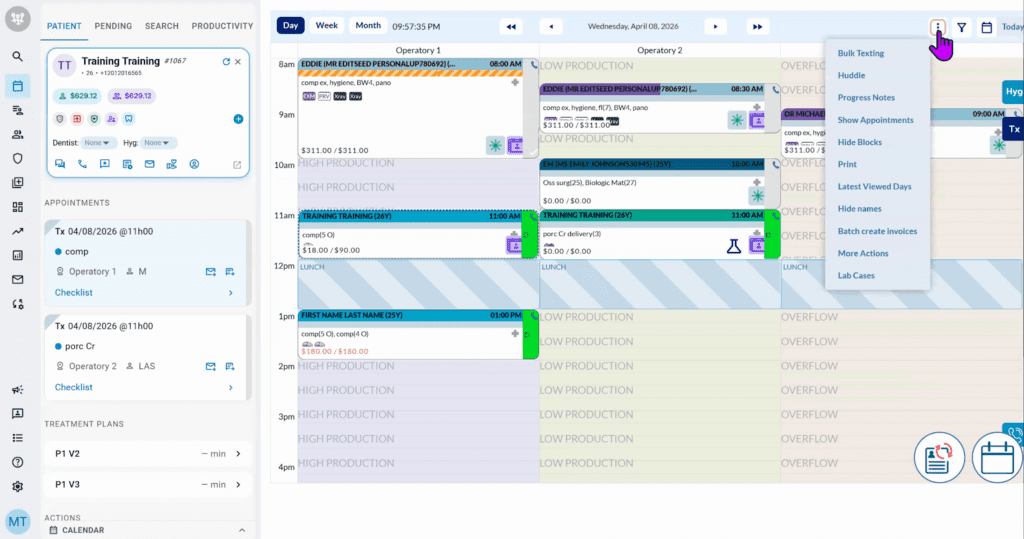 Block scheduling is the foundation of effective dental office scheduling. Start by reserving your most valuable time slots for high-production procedures (e.g., crowns, implants, complex restorative work) and build supporting appointments and hygiene visits around them.
Many practices pair block scheduling with a day template that assigns specific procedure types to specific times of day or week, keeping the structure consistent even as individual appointments change. The result is more predictable production and fewer mid-day bottlenecks.
When high-value appointments consistently anchor defined windows, your team can plan around them rather than scrambling to accommodate them at the last minute. Over time, this scheduling structure also protects against the revenue fluctuations that come with a disorganized calendar.
2. Cut No-Shows with a Two-Step Reminder System
No-shows are among the most disruptive, preventable time wasters a dental practice faces.
The most effective approach is a structured two-step reminder system, with one reminder automatically sent roughly a week before the appointment, and a follow-up the day of. Text consistently outperforms email for patient response rates, so lead with that channel.
For high-value or extended appointments, consider collecting a deposit at booking. A financial commitment raises the patient’s stake in showing up and eliminates the awkward fee-chasing that follows a last-minute cancellation.
3. Delegate Everything That Doesn’t Require Your License
One of the most persistent time drains in any dental practice is the tendency, often well-intentioned, for providers and owners to hold onto tasks a trained team member could handle just as effectively. Appointment confirmations, billing inquiries, insurance follow-up, and supply ordering don’t require a dentist.
Effective delegation starts with clearly defined roles, documented expectations, and the confidence to let your team execute without constant oversight. Resisting the impulse to step in because it feels faster in the moment is part of the process.
Over time, freeing yourself from these tasks keeps you in the chair doing the clinical work only you can perform. Effective time management for dentists means protecting that clinical time at all costs.
4. Automate Repetitive Administrative Tasks
 Time management for dental practices often suffers when teams spend hours each week on work that dental practice management software could handle in minutes. Manually processing insurance claims or re-entering patient intake data may seem like small tasks, but they add up to significant time loss when they happen every single day.
Automation redirects your team’s attention toward work that actually requires human judgment. The strongest candidates for automation include appointment confirmations, recare outreach, billing workflows, insurance eligibility checks, and patient intake forms.
It’s also worth taking an honest stock of how well your current tools are actually being used. Many practices only tap into a fraction of the features they’ve already paid for, often because full functionality was never implemented after onboarding.
5. Run a Morning Huddle Every Single Day
A 10-to-15-minute morning huddle is one of the highest-return habits a dental practice can build, and one of the easiest to abandon when the morning gets hectic. Skipping it is a mistake you’ll feel by noon.
Before the first patient arrives, review the day as a team. Cover confirmed appointments, any cases requiring special prep, the production goal, and who owns which tasks.
A brief huddle also creates space to catch problems before they compound. An outstanding patient balance, a missing supply, or a case that will likely run long is far easier to handle at 8:50am than at 11:30.
6. Set Daily Production Goals
Running a full dental schedule without a defined production goal is like navigating without a destination: you stay busy, but the direction stays unclear. A concrete daily target, grounded in your practice’s overhead and realistic capacity, gives your team a shared objective to organize the day around.
Visibility matters just as much as the number itself. When scheduling and analytics tools surface production data in real time, your front office can make smarter mid-day calls without digging through a spreadsheet.
Filling a last-minute gap with the right appointment type, or flagging a pending treatment case that could shift the day’s outcome, becomes much easier when everyone can see where things stand. A shared production goal creates alignment, not pressure.
7. Conduct Formal Time Studies to Build a More Accurate Schedule
Most dental office scheduling systems are built around habit and intuition rather than real data, which is why some appointments consistently run long and the day rarely reflects the plan on paper. Formal time studies address the root cause.
The process involves discreetly tracking how long each procedure type actually takes, from the moment a patient is seated to when they leave the operatory. Aim for at least four to five repetitions per procedure to get accurate averages rather than optimistic ones.
Once you have real data, rebuilding your scheduling templates around it is straightforward. The process takes several weeks to complete properly, but the accuracy gains carry through every part of your scheduling system.
If you plan to implement this tip, assign the tracking to a dental assistant and avoid telling the person being timed. Awareness of being observed changes behavior and skews the data. Distributing different procedure types across multiple assistants keeps the process moving efficiently.
8. Optimize Appointment Duration Based on Revenue Data
Not all appointment slots carry equal weight, and scheduling as though they do leaves both time and production on the table. Looking at your schedule through a revenue lens surfaces useful patterns: which procedure types generate the most production per chair hour, and which time blocks consistently underperform.
Once you identify those patterns, adjusting slot lengths and block frequency lets you extract more from the dental schedule you already have, without adding patients or cutting care short. Revisiting these adjustments quarterly keeps the schedule aligned as your case mix and patient volume evolve.
Longer appointments for high-value procedures and tighter windows for routine care mean your schedule structure reflects what each hour is realistically capable of producing. Optimization here is about precision rather than speed.
9. Choose Software with Time-Saving Features Built In
The right practice management platform returns time across your entire workflow, from the moment a patient books to the moment a claim is paid. When evaluating dental software, prioritize platforms that include:
- Automated appointment reminders via text and email
- Two-way patient messaging for confirmations and follow-ups
- Online self-scheduling that prevents double-bookings without front desk involvement
- Digital intake forms patients can complete before they arrive
- Built-in appointment checklists that confirm patients are ready before they walk in the door
- Automated insurance claim processing and eligibility verification
- Real-time production dashboards that surface where the day stands without a manual report
The most important criterion is that these features are native to the platform, not purchased as separate add-ons. Fragmented tools create their own inefficiencies, and toggling between systems costs more time than most practices realize.
Improve Time Management at Your Dental Practice with Oryx
Oryx brings together all the tools covered in this post, built into a single platform designed by a practicing dentist. Risk-centered scheduling with appointment checklists, automated reminders, two-way texting, digital pre-visit forms, online self-scheduling, real-time production dashboards, and automated insurance processing are all included natively. Your team gets the efficiency of a fully integrated system without the overhead of managing separate tools.
Learn more about our all-in-one dental software today. If you’d like to see how Oryx can save you time, please schedule a demo.