Key Takeaways
- 01 Dental charting is one of the most time-consuming parts of a clinical day, and AI tools exist specifically to reduce that burden without sacrificing accuracy.
- 02 AI dental charting often covers three distinct capabilities: voice-based periodontal charting, automated clinical note transcription, and AI-assisted radiograph analysis.
- 03 Voice AI perio charting allows hygienists to call out measurements hands-free and have them logged in real time, typically without a second team member, which is a meaningful advantage as staffing shortages persist.
- 04 AI clinical note tools listen to provider-patient conversations during the visit and generate structured documentation automatically, so notes are ready before the patient leaves.
- 05 Beyond aiding diagnosis, AI imaging analysis creates annotated, exportable documentation that flows directly back into the patient chart, removing the manual transcription step.
Think about how a typical hygiene appointment flows. The hygienist picks up a probe, starts working through a full-mouth perio exam, and calls out six measurements per tooth while a second team member scrambles to record each one. If no assistant is available, the hygienist has to stop, chart manually, then return to the patient. After the appointment, there are still clinical notes to finish. Somewhere between patient care and documentation, the day runs long.
Fortunately, AI dental charting tools make it possible to automate the most time-consuming parts of that workflow — capturing periodontal measurements hands-free, generating clinical notes in real time, and translating imaging findings directly into the patient record — without disrupting how the rest of the appointment runs. If you’re interested in using AI for dental charting at your practice but want to make sure the tools you adopt are actually worth it, review our guide to what these tools are and how they work.
What Is AI Dental Charting?
AI dental charting uses voice recognition, machine learning, and computer vision to automate documentation tasks, reducing manual entry, charting time, and errors across the clinical workflow.
The term gets used loosely, but dental charting AI often describes several distinct capabilities, three of which show up most consistently across dental platforms:
These three tools can work independently, but they are most powerful when they exist inside the same PMS platform. A finding flagged on an X-ray can inform a note, and that note can connect directly to a treatment plan. All of it happens without leaving the platform or re-entering data, leading to compounding gains in efficiency.
Keep in mind that not all practice management software (PMS) includes all three capabilities, and implementation quality varies considerably.
Why Is AI Dental Charting Needed?
According to the ADA Health Policy Institute, only 60% of dentists currently have an adequate number of hygienists on staff, and among those actively recruiting, 91% say it is very or extremely challenging to hire one. Staffing issues ranked as the top challenge heading into both 2025 and 2026.
When the traditional two-person charting model depends on a second set of hands that is increasingly hard to find, the operational math stops working.
AI dental charting tools are one direct response to that problem. By automating periodontal charting, note-taking, and imaging analysis, these tools allow providers to stay focused on the patient while the system handles the record.
The result is less time lost to administrative tasks, fewer documentation errors, and a workflow that holds up even when you are short-staffed.
3 Capabilites of AI for Dental Charting You Should Know
Each of the three core AI charting capabilities targets a different friction point in the clinical day: the labor of perio documentation, the drag of after-hours note-writing, and the gap between imaging findings and the patient chart. When you understand what each one actually does, it easier to evaluate whether a platform is delivering real workflow improvement or just labeling existing features with an AI badge.
If you’d like to ensure the PMS you choose is actually providing a useful AI tool, learn more about three primary dental charting AI features that any dental owner or office manager should know:
1. What Is AI for Periodontal Charting?
AI perio charting uses voice recognition to log probing depths and clinical findings hands-free in real time, allowing hygienists to complete a full-mouth exam without a second team member.
Periodontal charting is also one of the most labor-intensive parts of the hygiene appointment, which is why dental charting AI tools have focused more development attention on this task than almost any other.
A complete full-mouth exam means recording up to 168 individual data points: probing depths, bleeding on probing, recession, furcation involvement, and mobility for each tooth. Done manually, that process takes 10 to 15 minutes and typically requires a second person in the room.
In practice, the hygienist calls out measurements naturally — “distal 3, bleeding,” “buccal 4” — and the AI, trained specifically on dental clinical terminology, captures each reading and populates the chart in real time. Without an assistant, a clipboard, or any manual entry, the provider can stay focused on the patient from start to finish.
The technology underlying this is speech recognition built specifically for the dental environment, not a general-purpose voice assistant. This distinction matters because general consumer voice tools are not trained on clinical language, do not understand probe depths within a charting workflow, and are not HIPAA-compliant.
In contrast, dental-specific voice AI is purpose-built to recognize the structure of a perio exam, including sequencing, tooth numbering, and clinical shorthand, even in a noisy operatory.
Beyond the time savings, AI for periodontal charting offers a few other advantages:
2. What Are AI Clinical Notes?
AI clinical notes are structured documentation generated automatically during the appointment. The AI listens to the provider-patient conversation and produces a draft note ready to review before the patient leaves.
For most providers, documentation does not end when the patient leaves the chair. Notes get finished between appointments, during lunch, or after the last patient of the day. After-hours charting adds up quickly, and because it is done from memory, it is more prone to gaps than documentation captured in the moment.
Rather than asking the provider to dictate or type after the fact, the AI captures what is said between the provider and patient and identifies clinically relevant content, such as the chief complaint, exam findings, diagnosis, and treatment discussed. A structured note is generated in real time so that by the time the appointment ends, a draft is ready to be reviewed, edited if needed, and saved to the patient record.
Beyond the mechanics, AI clinical notes change three things about how a practice runs:
3. What Is AI Imaging Analysis?
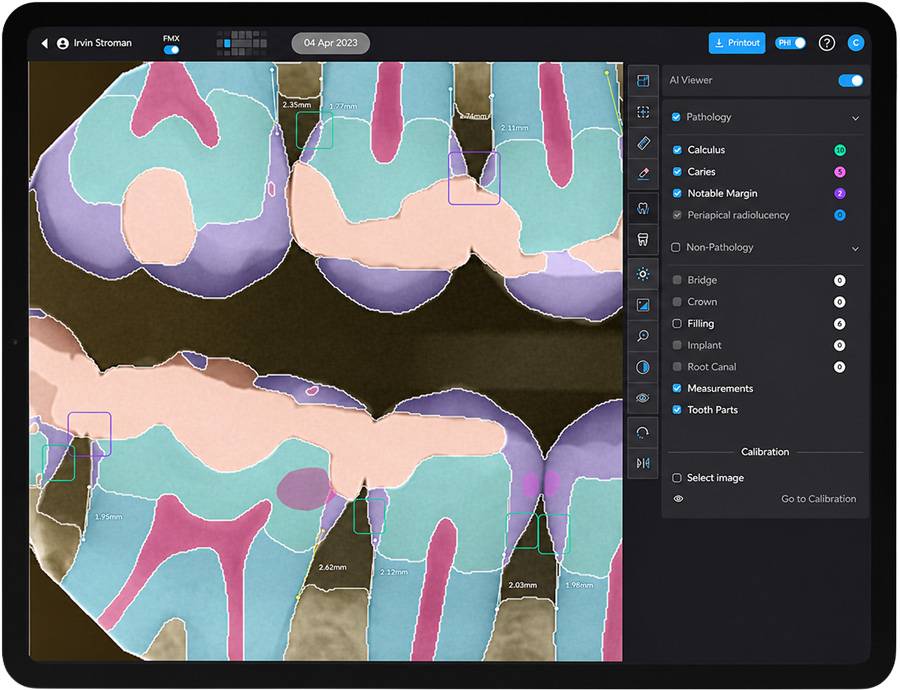
AI imaging analysis uses computer vision to review dental radiographs in real time, flagging conditions and generating annotated documentation that flows directly into the patient chart.
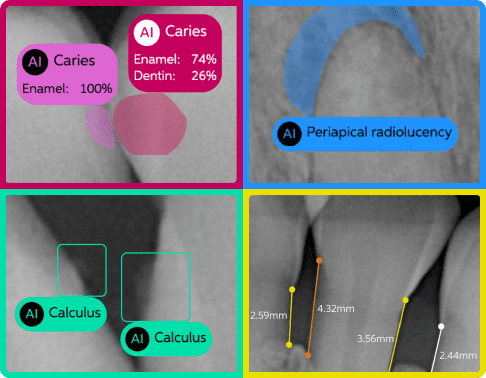
AI imaging analysis gets the most attention in the dental AI conversation, and most of that attention focuses on diagnosis, such as detecting caries, bone loss, calculus, or periapical lesions on radiographs. What is often underdiscussed is what happens to those findings after the diagnosis and how much manual work is currently required to turn them into a patient record.
When AI imaging is integrated directly into a practice management system, it handles that documentation work automatically while also doing a few other things worth understanding:
How Does Oryx Use AI in Dental Practice Management?
Oryx embeds four AI capabilities directly in the platform: automatic clinical notes, guided exam charting, voice-based perio charting, and FDA-cleared diagnostic imaging from Pearl or Overjet.
AI Imaging with Overjet: Another Milestone
Recently, Oryx logged a new chapter in its AI story by announcing a partnership with Overjet, the world leader in dental AI. This partnership allows Oryx to integrate Overjet’s FDA-cleared clinical AI into its practice management software to give providers real-time AI analysis. Oryx users are now able to detect caries, calculus, bone levels, periapical radiolucencies (PARLs), anatomical structures, and more. The new AI features work seamlessly alongside existing features and workflows.
In practice, this means more consistent, confident diagnostics, increasing clinical efficiency without the risk of sacrificing quality. Patients will have a better understanding of their treatment options, increasing case acceptance rate.
Beyond Imaging: Oryx’s AI Journey
Of course, Oryx’s use of AI didn’t start with Overjet. As mentioned, this is a continuation, not a beginning! While Oryx has been integrating varying forms of AI into its software from the start, the biggest milestone came in 2023 with a partnership with Pearl to unlock Oryx’s first integration for AI-powered imaging.
Oryx integrated Pearl’s Second Opinion® disease detection capabilities within its native dental imaging feature set to assist dentists in the detection of numerous common conditions in bitewing, periapical, and panoramic x-rays of adult teeth. For years, Oryx-backed dentists have been able to review intraoral images, scans, and radiographs within the native imaging utility of Oryx’s PMS.
Other examples of existing AI use in Oryx PMS include:
- Voice Perio Charting: Record precise periodontal measurements hands-free with advanced voice recognition, improving accuracy and efficiency chairside.
- Transcribe & Summarize: Instantly capture patient conversations, dictate clinical notes, and condense everything into accurate, easy-to-read summaries for complete, hands-free documentation.
- Treatment Planning: Automatically generate exam notes and personalized patient reports to help people understand their oral health and evidence-based treatment plans.
- Patient Communications: Oryx Automate is designed to handle everything, including appointment reminders, insurance paperwork, and billing reminders—all on autopilot.
These are just a few of the ways Oryx is capable of integrating AI to promote ease, accuracy, and efficiency for staff alongside better experiences for patients. The team continues to develop new, AI-backed features as the industry evolves.
AI for DSOs and Multi-Location Practices
Oryx specializes in supporting dental support organizations and multi-location practices as they scale and expand across a growing number of locations. As they grow, these groups benefit from AI-driven treatment planning, centralized performance insights, and streamlined communication.
AI helps parse through this database to deliver real-time insights that assist with decision-making and support effective scaling. It also streamlines operations and supports standardization of the patient experience across locations. William Kohl, founder of Fi IT, says, “Investments in technology ultimately lead to a better patient experience.”
Clearly, Oryx is not new to the AI game. In fact, the team continues to add chapters to the organization’s AI story regularly. New partnerships and new features come together seamlessly as Oryx builds the future of dentistry.
Training AI: The Best of the Best
We all know it, but it’s still important to keep in mind: AI in dentistry is only as good as the patterns it learns from. Fortunately, Oryx’s clinical foundation is rock solid.
Oryx’s founder, Dr. Rania Saleh, was trained by the best and brightest at the Kois Center, which specializes in evidence-based dentistry to enhance clinical outcomes.
Oryx’s automation and AI features are guided by decades of human expertise and experience. Really, AI is just the student. The Oryx team takes on the role of seasoned instructor—and it shows.
In the latest G2 Grid® Report, Oryx was named a High Performer in both its overall Dental Practice Management Grid® and the Small Business segment. Out of 13 reviewers, 12 gave us a 10 out of 10 rating, and 100% agreed that Oryx is moving in the right direction. This recognition isn’t just an empty accolade. It reflects real-world validation from the people who use the software every day.
What’s Next: Building Toward the Future of AI in Dentistry
At Oryx, AI isn’t an abstract concept. It’s already working to simplify and elevate dental care for its users. In the future, AI may evolve, prompting fine-tuning on predictive analytics, real-time decision support, and deeper automation. But in the meantime, AI is already putting in work every day for dental practices of all types and sizes.
As AI technology evolves, Oryx is committed to responsible, expert-guided use that makes life easier for dentists. After all, if AI is the student, the Oryx team is the tenured professors.
Take the next step toward a smarter practice today. See Oryx AI in action with a personalized demo.